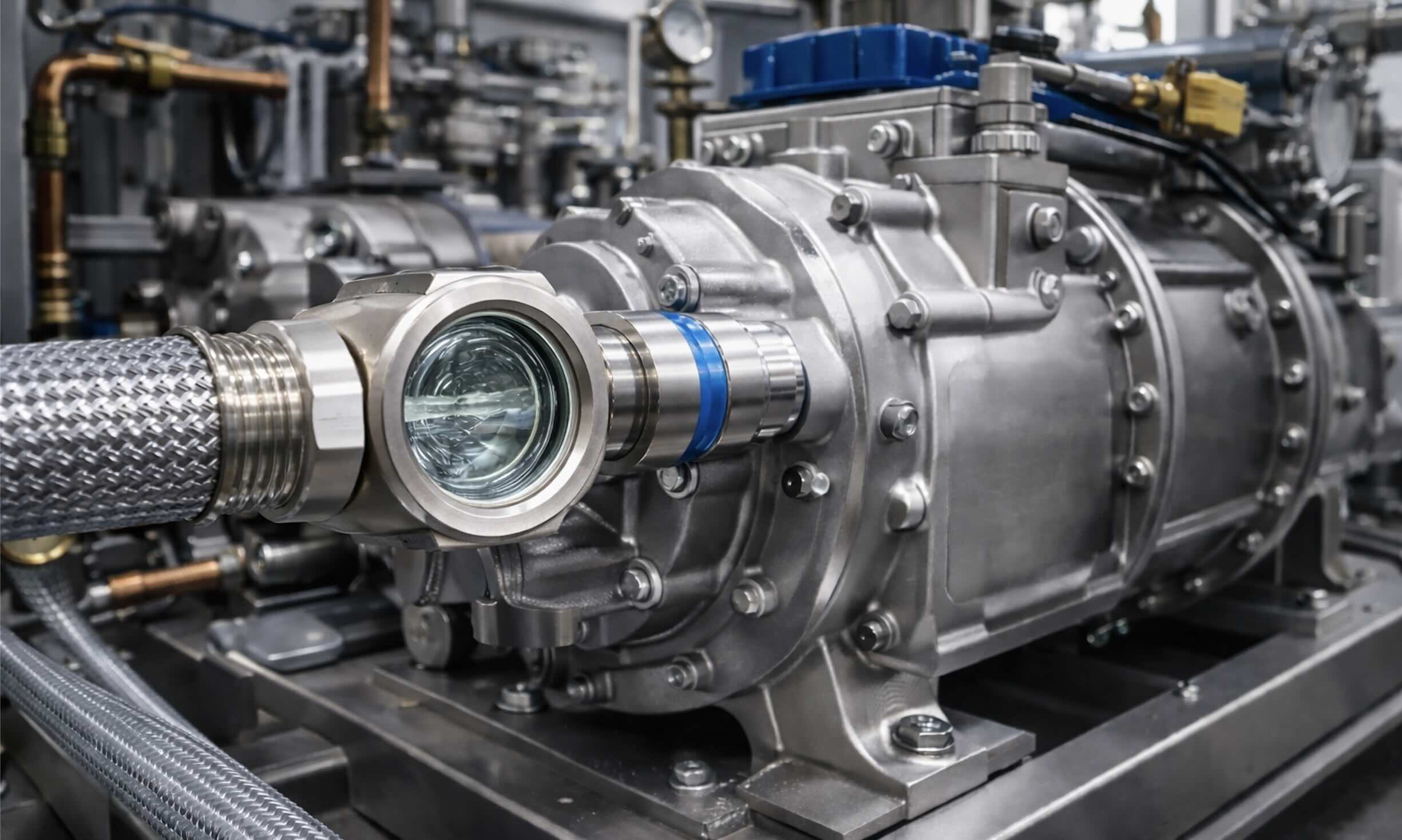
Direct visual confirmation for supercritical and liquid-line CO₂ applications
Modern CO₂ (R744) refrigeration systems operate close to the thermodynamic limits of the working fluid. High operating pressures, frequent pressure and temperature cycling, and rapid phase transitions are inherent to transcritical CO₂ operation. Under these conditions, small changes in load or heat rejection can cause flashing, vapor entrainment, or unstable liquid delivery.
While pressure transducers, temperature sensors, and control algorithms are essential, they do not provide complete visibility into real flow conditions. Instrumentation reports point values, but local flow state can deviate significantly from inferred conditions. Mass flow may appear acceptable while vapor bubbles, flashing, or oil entrapment are already present. Near the critical point of CO₂, property correlations degrade and state estimation becomes increasingly unreliable.
A properly designed high pressure sight glass provides direct, real time confirmation of flow conditions. Unlike inferred measurements, a sight glass does not rely on models, calibration, or time-averaged signals. It is immune to sensor lag, drift, or control assumptions. It shows exactly what is happening in the line under actual operating conditions.
Encole CO₂-rated high-pressure sight glasses are engineered specifically to deliver this level of certainty in R744 liquid line refrigeration systems.
Many sight glasses used in CO₂ systems were originally designed for HFC refrigerants and later pressure rated for higher service. Although they may meet nominal pressure requirements, they are often not engineered for the unique mechanical and thermal stresses associated with CO₂.
CO₂ refrigeration systems experience:
These conditions place exceptional demands on sight glass windows, seals, and housings. Over time, inadequate designs can suffer from seal degradation, window damage, reduced optical clarity, or sudden mechanical failure. In the best case, visibility is compromised. In the worst case, the sight glass becomes a system risk.
A sight glass intended for CO₂ refrigeration service must be designed around these realities from the outset.
Encole sapphire sight glasses are purpose built for transcritical and supercritical CO₂ refrigeration systems, with emphasis on liquid line locations where visual verification is most critical.
Typical installation points include:
At these locations, the sight glass enables operators and commissioning engineers to immediately verify whether stable liquid CO₂ is present, or whether flashing, vapor entrainment, oil carryover, or contamination is occurring. This information is especially valuable during startup, commissioning, load changes, and fault diagnosis.
The assembly is rated for continuous operation up to 130 bar in CO₂ service and is designed to tolerate repeated thermal and pressure cycling without loss of sealing integrity or optical performance.
A properly specified CO₂ sight glass provides information that would otherwise require extended troubleshooting or indirect interpretation:
This direct visual feedback shortens commissioning time, reduces unnecessary adjustments, and improves confidence in sensor-based diagnostics.
The sapphire viewing window, housing geometry, and NPT mounting interface are engineered to withstand both static pressure and dynamic loads associated with CO₂ operation. The sealing approach avoids materials that degrade under low temperatures or repeated thermal cycling, and all wetted components are compatible with CO₂ and common refrigeration contaminants.
The compact internal geometry minimizes dead volume, reducing the likelihood of localized flashing within the sight glass itself. This ensures that observed flow conditions accurately represent the actual state of the line.
This sight glass is designed to complement pressure, temperature, and flow instrumentation, not replace it. In modern R744 systems, visual confirmation provides an essential layer of validation that improves reliability and reduces operational risk.
For engineers designing, integrating, or operating CO₂ refrigeration systems, visual certainty is not a luxury, it is a practical tool for safer commissioning, faster diagnostics, and more robust system performance.