Elastomer seals such as O-rings will melt over 300C temperature. How do you hermetically seal things above 300C degrees? With metal seals or brazing windows into the housing.

Operating temperatures of sight glasses often exceed 300C in some applications. This is the stated cutoff for fused, bonded or gasketed sight glasses. Albeit, for smaller apertures, where thermal expansion of the metal housing is less of an issue, the glasses may operate at 300C and above, however this is not a recommendation and needs to be tested before use.
Sight glasses that are specifically designed for temperatures up to 450C are of brazed type, where the glass is brazed to a metal housing. This is easier said than done as the glass is rarely brazed directly to a metal housing. First the glass is metallized, which is the process of depositing a thin layer of metal onto the edge of the glass. This is done by metal evaporation or metal splattering techniques. The metal being applied is typically Titanium. After the edge of the glass is coated with Titanium, then the brazing step follows. Brazing is typically done with clear materials such as sapphire or quartz, less often with borosilicate. This is because of differences in optical transmission and tolerance to thermal shock between these materials. Quartz has the best resistance to thermal shock among borosilicate, and sapphire. When brazing is done, the quartz (or sapphire) are brazed to a secondary sleeve, which later is then welded to the main housing. The purpose of this intermediate sleeve is to accommodate the inevitable mismatch in thermal expansion between metal and the quartz (or sapphire).
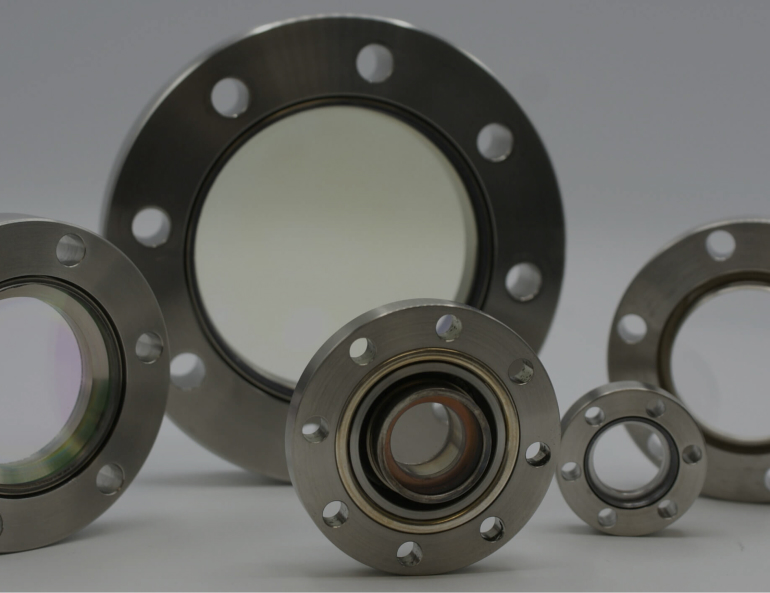
The sleeve has a thin wall thickness, in the order of 0.005 inch to 0.030 inches, and is made of a type of Kovar that closer matches the coefficient of thermal expansion (CTE) of the sapphire or quartz. The entire assembly of the quartz, sleeve and the housing is designed in such a way as to remove any stresses from the sleeve. This is because the sleeve is thin. Here lies the challenge of this type of design: the sleeve by itself cannot take the working pressure of the product, yet, the sleeve creates a hermetic seal with the brazed quartz. The rest of the design is very particular about properly supporting the sleeve/quartz assembly. The axial stresses and the radial (hoop) stress of the assembly are transferred into the main housing. The result is the sight glass with fully supported quartz. Thinner sleeves are designed for Helium leak tight for vacuum applications, thicker sleeves for high pressures.
Another sealing method for high temperature is with a metal seal. This method provides a robust viewport, suitable for operation at high pressure and high temperature at the same time.
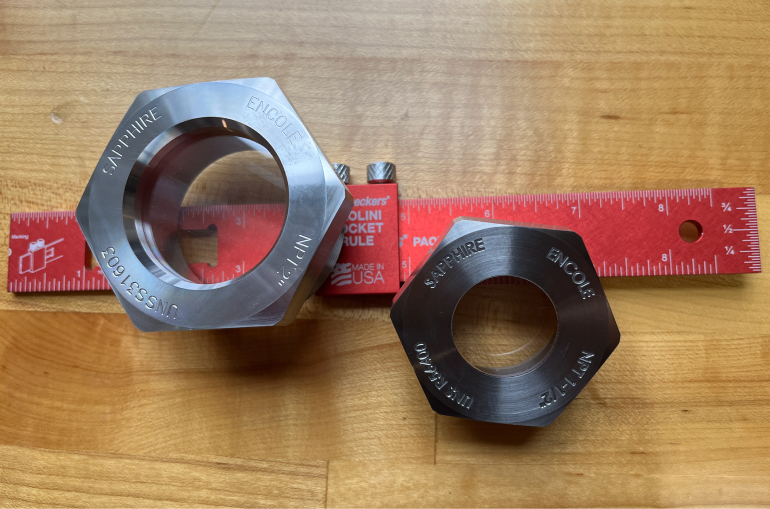
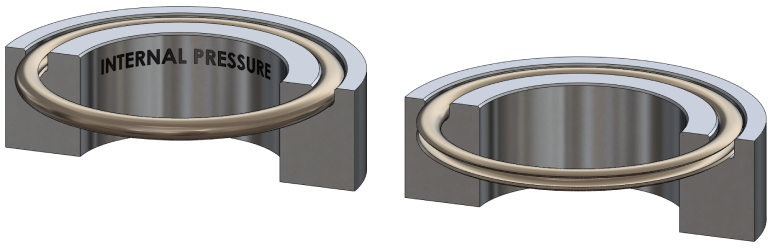
These sight glasses use metal seals for internally sealing the window into the housing. Here is an example of the metal C-seals. Notice, C-seals are unidirectional. Pressure facing the inside of the seal vs. outside of the seal determines the seal groove size and the sight glass viewing aperture.
We took it upon ourselves to design a high temperature sight glass with no brazing. The advantages of that are potentially lower cost, stronger sight glass, and better control of the assembly. This is a work in process and it involves metal seals made of Waspaloy.