Benefits for using natural language as commands: Create a sketch, make curves relationships, assign lengths, angles and spacing. Create an extrude, cut, revolve, sweep and loft features from a given sketch. Each CAD system has a similar but unique way of using its commands. Natural language puts the design engineer in charge of engineering rather than operating a CAD system. Neural Concepts is pioneering the use of natural language in computer aided design. PhysicsX is developing large-scale physics AI models that can interpret engineering intent and generate design concepts. Startups like nTop are also pushing implicit modeling and AI-driven geometry generation. SolidWorks LEO & AURA is a step into AI augmented design generation.
Taking it further, AI copilot can generate a new design from a given design target, within the context of manufacturer' established product lines. Admittedly, this can be an unexpected "surprise me" moment when a new design is in. With sufficient human intervention and adjustments, this approach is a symbiotic process. Feature recognition is another benefit where GD&T inconsistencies are flagged or fixed.
A large FEA runs on a workstation with 15 GB per million degrees of freedom - about 45 GB per million solid nodes in structural analysis. FEA for a single part may have as little as half a million nodes, up to 10 million nodes for a complex part. This does not seem like a requirement for an NVIDIA H100-based data center computers, massive, purpose-built rack servers. However, for handling large training datasets while running several FEA's for multiple clients, a computer of that size is a far cry from a typical desktop or workstation. A data center will aid replacing slow, expensive engineering simulations with AI models, offering scalability, security, and CAE software integrations. For instance: PhysicsX runs natively on NVIDIA accelerated computing and the NVIDIA CUDA-X accelerated stack, and integrates directly with NVIDIA PhysicsNeMo alongside PhysicsX's own Large Physics and Geometry Models. PhysicX is cloud-first company, not an on-premises one. Would it make sense for a large manufacturing company to duplicate this capability on premises, to a limited extend of their product lines? Unlikely, it's cheaper to rent.
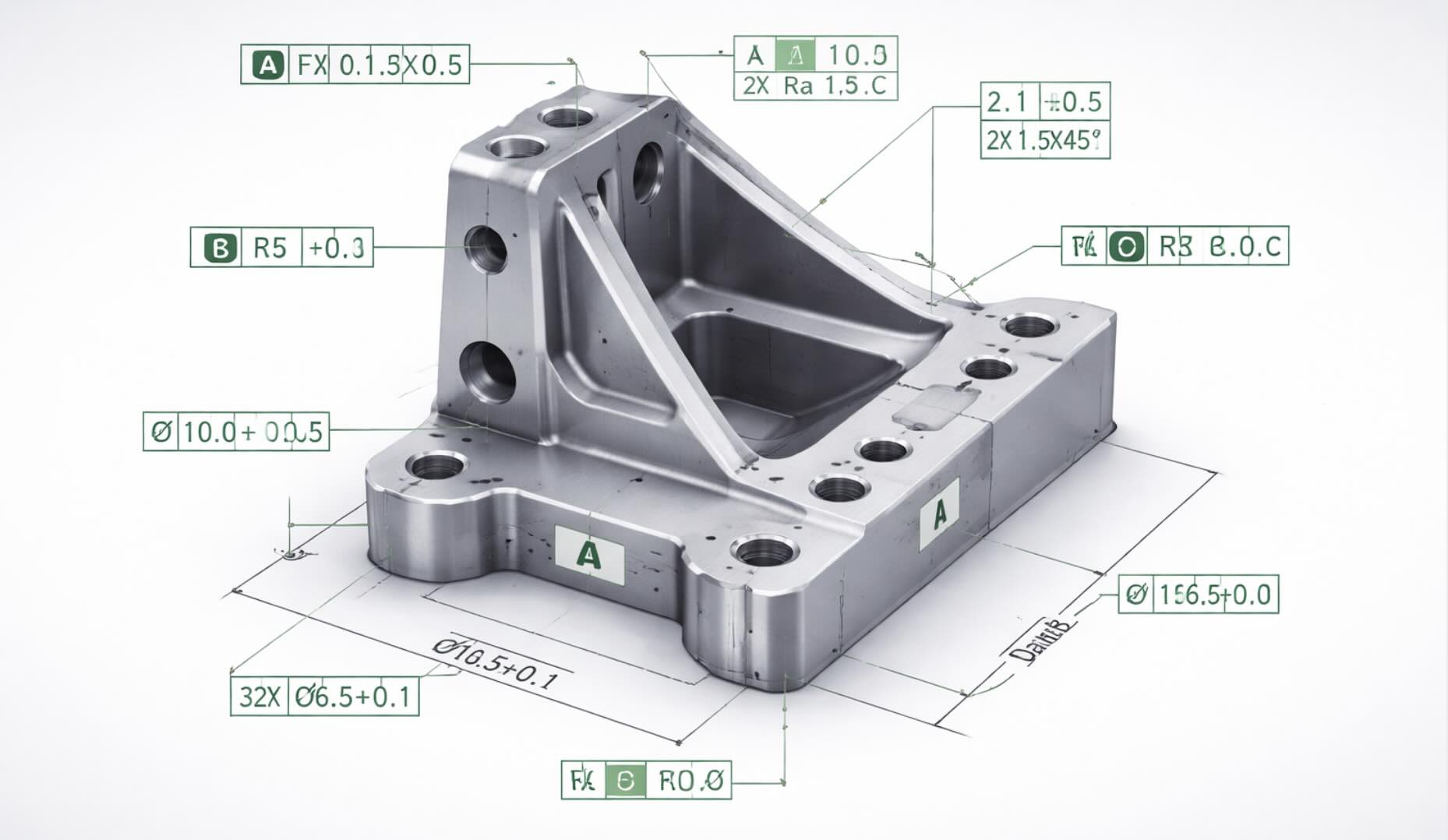
In context of Model-Based Definition (MBD), how does machine learning contribute? Under MBD, GD&T is attached directly to geometric features as semantic data. In an MBD the 3D model is not just geometry; it carries Product Manufacturing Information (PMI), including dimensions, tolerances, datums, and notes. ASME Y14.41 Standard defines how this information is embedded and exchanged. The result is that the model is the authoritative source, replacing the traditional pairing of model plus 2D drawing. MBD does not change GD&T or how it's interpreted. GD&T is governed by a Standard. All symbols are rendered the same regardless if viewing them on paper or a computer screen. In a traditional workflow, GD&T communicates requirements between people. In an MBD and AI-enabled workflow, it becomes a set of constraints that software can interpret and act on directly. That means the system understands what a tolerance constrains. Datums, feature control frames, and tolerance zones become machine-readable objects rather than annotations. This changes the role of the engineer. Less effort goes into drafting and annotation, and more goes into refining the design and manufacturability.
Despite these benefits, adoption is uneven. Many supply chains still depend on 2D drawings, and a significant portion of industry uses non-semantic annotations even within 3D models. Interoperability between systems is improving but not fully resolved, particularly when exchanging complex tolerance definitions. Until there is an alternative to a Portable Digital File reader directly from any CAD system, a 2D PDF file remains a contract of the intent and deliverables.
AI is also changing the simulation side of CAD in ways that are less visible than generative geometry, but arguably more impactful on the design.
Mesh generation is one of the persistent bottlenecks in simulation. High quality meshes require significant manual tuning. AI is starting to remove much of this trial and error. From prior simulation setups and outcomes, AI can automatically apply mesh controls to load-bearing features and contact regions. Companies such as Ansys and Dassault Systèmes are incorporating AI-assisted meshing and solver acceleration into their simulation products.
In parallel, Physics-Informed Neural Networks (PINNs) are emerging as a different approach to simulation altogether. PINN build models trained on historical simulation data and boundary conditions. This allows to approximate solutions without explicitly meshing the geometry in the traditional sense. As these models mature, they are beginning to deliver analysis velocity and improved accuracy.
Prediction: Over the next several years CAD models will likely be executable driving manufacturing and inspection without reinterpretation. AI will expand its role in proposing designs and tolerances, but the quality of the output will depend on intent definition. MBD provides the framework that makes this possible. GD&T becomes a data structure that ties design intent with part fabrication.