
High Temperature Flanged Sight Window for Schlieren Visualization
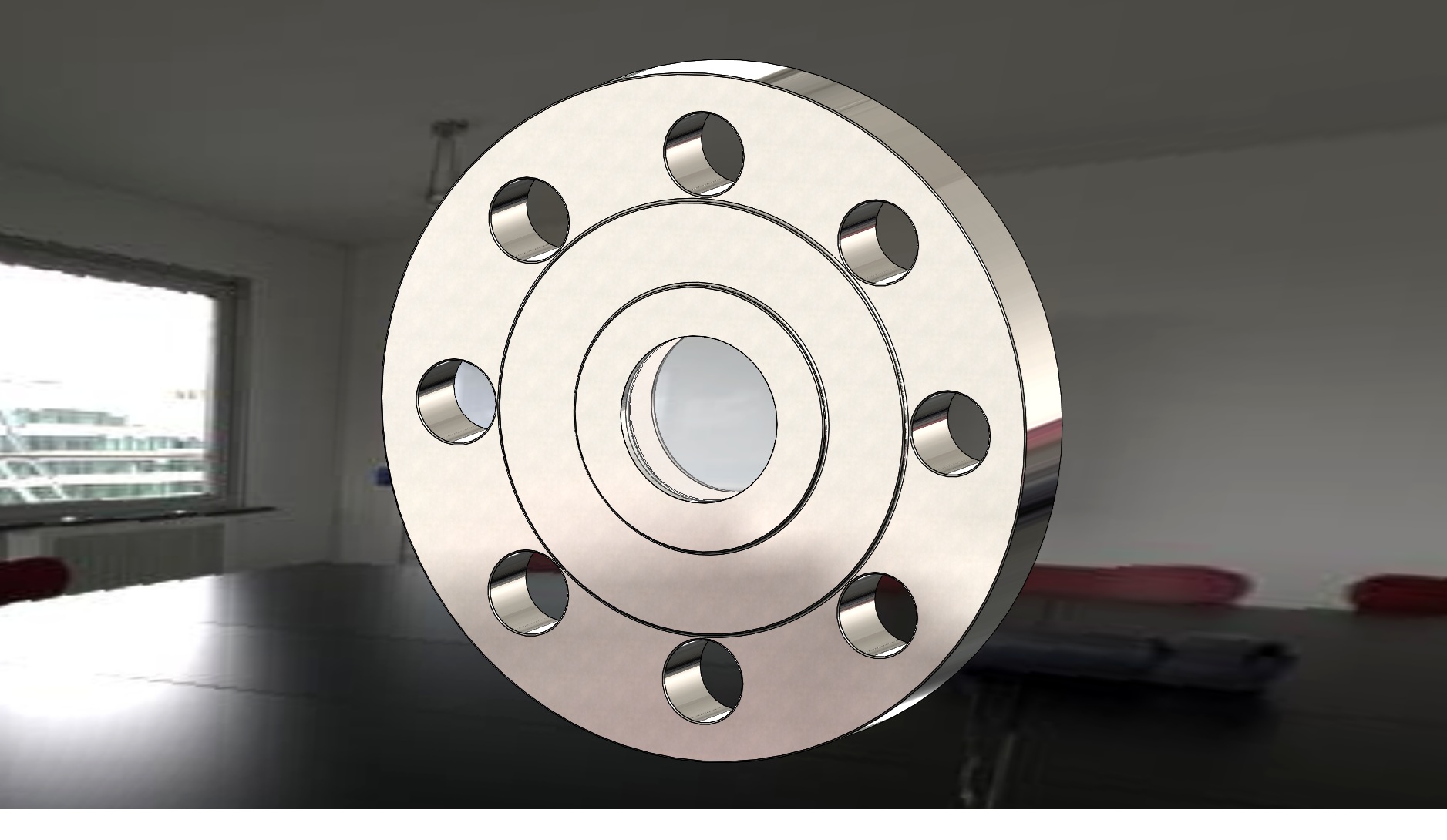
Sapphire window is flush, (on the same plane) with the flange process side. PN 102260
Optical distortions caused by air
turbulence are commonly observable under high-temperature conditions, such as
above heated ground on a hot day. These distortions arise from fluid flow - induced
variations in mass density, which lead to spatial gradients in the refractive
index of the fluid. As light propagates through such a non-uniform medium, its
trajectory and effective velocity are altered, producing measurable optical
deflections. Schlieren visualization techniques are based on this principle,
enabling the visualization of refractive index gradients that are directly
correlated with fluid flow behavior [1].

In fluidized bed reactor applications,
a high-pressure Encole sight glass is employed to separate the pressurized
process gas within the reactor vessel from a high-speed camera used for
Schlieren imaging. The camera and associated optical instrumentation are
installed in a dedicated cabinet located external to the reactor. An optical
tube establishes a direct line of sight between the camera and the process
volume while isolating the optical path from the surrounding environment. This
configuration minimizes optical disturbances caused by ambient air turbulence.
The sight window is designed to transmit light across the visible spectrum to
support Schlieren visualization.
A critical design requirement of the
viewing window is the presence of smooth surface that does not disturb the
natural flow field within the reactor vessel. The sight glass is engineered to
operate under the following conditions:
·
Continuous operating pressure 344 bar
·
Continuous maximum temperature 420°C
·
Integration
within EN 1092-1 or ASME B16.5 flanged connections
·
Optical
transmission in the wavelength range of 380–780 nm
·
Chemical
compatibility with digester gas, syngas, NOx, and products of hydrocarbon combustion.
Part Drawing, Encole Manufacturer Part Number 102260. Notice the sapphire
window on the pressure side is perfectly flush with the housing. In other
words, the window is in plane with the flange. This configuration allows for undisturbed
boundary layer at the wetted end of the sight glass assembly.